Knights Radiant
The Way of KingsThe Knights Radiant were an ancient order whose legacy shapes the meaning of power, history, and collective responsibility. They are remembered as the original bearers of Shardblades, warriors who fought the Voidbringers with weapons beyond ordinary Shardblades, and a disciplined community guided by The Way of Kings. By the time of Dalinar Kholin’s visions, the order survives chiefly as a broken memory, yet its ideals become an urgent political and moral command: the Knights Radiant must stand again.
Nature and Historical Function
The Knights Radiant were not merely an elite army. The Way of Kings describes them as a community that used its power according to a guidebook and a way of living, while later testimony connects their old religious and military world to the struggle against the Voidbringers. Their weapons were created for enemies whose bodies could withstand steel, including horrors of rock and flame that rose dozens of feet into the air. This history places the order at the intersection of warfare, spiritual discipline, and the defense of humanity itself.
Their Shardblades were treated as gifts of the god who enabled mankind to resist those ancient enemies. The weapons were not interchangeable equipment but unique and precious objects, each a masterwork with its own flowing design, glyphs, and patterns. At a meeting place chosen before battle, seven such swords stood point-first in the stone beneath a towering spire. Kalak recognized every one. Their presence proved that their masters had not simply abandoned them: if a Radiant had died, the Blade would have vanished. The swords therefore preserve a material record of the order’s survival, even when its members are absent.
The Order in the Ancient Past
The order belonged to an era of repeated Desolations, when ten figures were expected to meet after battle at a predetermined landmark. Kalak arrived beneath the spire expecting the survivors to gather, but found only Jezrien waiting. The battle had been among the worst, and the enemy had grown increasingly tenacious; the absence of the other eight suggested that the order’s leaders might have fallen. The scene presents Radiant history not as an unbroken legend of triumph but as a cycle of slaughter, return, and unbearable obligation.
The survivors were bound to a fate that extended beyond ordinary death. Kalak understood that dying sent him back, but surviving a Desolation was supposed to send him back as well—to the place of pain and fire that he dreaded. His thought that he might simply refuse to return is treated as dangerous and possibly treacherous. The order’s greatness is thus inseparable from coercive endurance: its champions are defenders, but they are also prisoners of a recurring duty whose end they cannot freely choose.
Power, Knowledge, and Distortion
The Knights Radiant became entangled with later religious history, although the surviving evidence distinguishes the order’s own ideals from the abuses of those who claimed authority over sacred knowledge. Kadash explains that the Hierocracy’s priests kept theology from ordinary people and replaced open understanding with control. They claimed visions and prophecies, even though such practices had been denounced by the Heralds, and associated the attempt to divine the future with Voidbinding, described as dark and evil.
When the Hierocracy was overthrown, the Sunmaker investigated the priests and their correspondence. The investigation found no genuine prophecies or mystical promises from the Almighty; the priests had fabricated them to placate and control the population. This history matters to the Knights Radiant because it separates authentic spiritual responsibility from institutional mysticism. The order’s legacy can be invoked by people seeking guidance, but it can also be appropriated by authorities who use mystery to command obedience.
That distinction is already visible in Dalinar Kholin’s family. Gavilar Kholin’s final message, written in his own blood on a fragment of board and addressed to his brother, urged the search for the most important words a man could say. Dalinar identifies the words as a quotation from The Way of Kings, a book Gavilar had favored near the end of his life and had discussed with him repeatedly. Dalinar has had the book read aloud several times, but still cannot find an explanation for the message. To Adolin Kholin, the connection instead appears to confirm that Dalinar’s visions and guilt over his brother’s death are intertwined with his fixation on the Radiants.
The Lost Order and Its Possible Return
Dalinar’s visions transform the Knights Radiant from a dead historical subject into an immediate political possibility. In one vision, he sees approximately two hundred Shardbearers approaching in formation. The number is staggering because Alethkar possesses roughly twenty Shardblades and Jah Keved a similar number; even the combined total of the rest of the world might only equal those two kingdoms. The army therefore exceeds every familiar measure of Shardbearer strength.
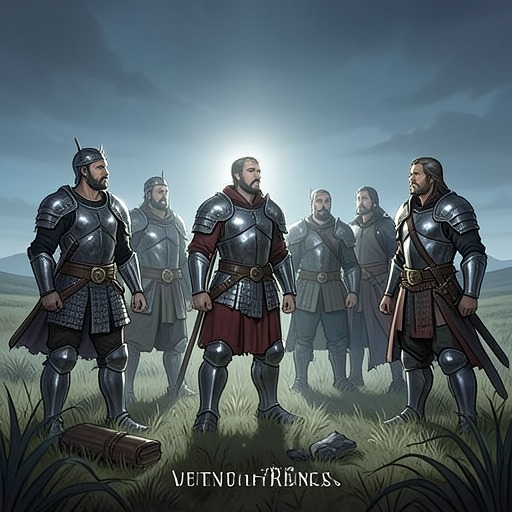
The approaching warriors are men and women of many races and nationalities. Their Shardplate is unpainted, but blue or amber light shines at the joints and across the glyphs on their fronts, matching the Radiants Dalinar has seen in other visions. They advance shoulder to shoulder in a crystalline wave, without drawing their Shardblades. Their order and restraint contrast with the ordinary logic of aristocratic warfare, in which a handful of priceless weapons are dispersed among competing kingdoms.
Yet the vision refuses to turn their appearance into a simple restoration. The Shardbearers walk away from Dalinar slowly and resolutely, their eyes fixed ahead, while a separate crowd of unarmored soldiers waits in the distance. They do not explain themselves when Dalinar asks why they are doing this. One former Shardbearer pulls free when he tries to stop him. The Radiants are therefore shown as a divided or departing inheritance: their power has returned in astonishing abundance, but their purpose and allegiance remain inaccessible.
Ideals and Narrative Significance
The decisive statement of the order’s future comes when a mysterious figure tells Dalinar that people must be protected and then recites the ancient oaths: “Life before death. Strength before weakness. Journey before destination.” The figure commands that the oaths be spoken again and that humanity receive back the Shards once borne by the Radiants. The declaration, “The Knights Radiant must stand again,” turns a historical memory into a task.
Dalinar admits that he cannot comprehend how this can be done, but promises to try. The figure then identifies the central danger: humanity’s enemies need not defeat the kingdoms directly if they can make people forget, turn against one another, and repeat the divisions of the past. The old legends say that humanity won, but the revealed truth is harsher: humanity lost, and is still losing. The Knights Radiant consequently signify more than renewed combat power. Their restoration requires shared action, recovered ethical discipline, and the refusal to let rival kingdoms become their own enemies.
The order’s narrative role is therefore deliberately paradoxical. Its Shardblades embody singular, almost unimaginable force, while its defining command is collective unity. Its history promises salvation but is marked by abandonment, fabricated prophecy, and the possibility that even its champions could flee their appointed return. The demand to restore the Knights Radiant is not a nostalgic appeal to a perfect golden age; it is a summons to recover the obligations that made power worth wielding before the next catastrophe makes the failure irreversible.